Wednesday, January 30, 2008

Govt sets Stolen Generations apology date (ABC.net.au)

The Federal Government has set February 13 as the day for a formal apology to the members of the Stolen Generation. The apology will be the first item of business for the new Federal Parliament and will be delivered by Prime Minister Kevin Rudd.

Indigenous Affairs Minister Jenny Macklin says the apology is on behalf of the Australian Government and will not be attributing guilt to the current generation of Australians. Ms Macklin says the content of the apology is still subject to widespread consultation, but she says it will form a necessary step to move forward.

A traditional Welcome to Country will be held as part of the Parliament's opening ceremony by members of the Ngunnawal people.Indigenous groups have warmly welcomed the announcement of a date for a formal apology to the Stolen Generations.

Christine King from the Stolen Generations Alliance says it will be a historic and emotional day. "Sorry is the most important word because it has great meaning in our community," she said. "It means having empathy and compassion and understanding."

The speech has not been written yet but the Ms Macklin says she is confident the timing of its delivery is right.

Aboriginal and Torres Strait Islander Social Justice commissioner Tom Calma, has welcomed the Government's move to say sorry. Mr Calma says suggestions that an apology will expose the Government to litigation are scaremongering. He says it is important to acknowledge what happened. "A sorry is a sentiment that expresses that somebody really does have feeling about the ills of the past and wants to make a move forward," he said. "I think that as a country, as a population, as a nation it will be good for all of us to go through such a cathartic experience." He says including the word sorry in the apology will not result in a flood of compensation claims. "The ill informed are promoting that type of idea, the judiciary, the Government themselves have gone through that sort of due diligence process to identify whether it would open any flood gates," he said. "It hasn't since the apology by all the states."

Liberal Indigenous affairs spokeswoman Sharman Stone says the Coalition should join Labor in an apology to Aboriginal people. Dr Stone's northern Victorian seat of Murray has the state's largest population of Indigenous people outside of Melbourne. She says the former Coalition government's Motion of Regret in 1999 did not go far enough to acknowledge past wrongs. "We are told by many Indigenous Australians that still is unfinished business," she said. "There wasn't a belief that it was really strong enough to be considered a Government apology for past laws, regulations and practices."

Article link

Study finds middle age is truly depressing (Reuters UK)

Tue Jan 29, 2008 1:25pm GMT
By Michael Kahn

LONDON (Reuters) - Middle age is truly miserable, according to a study using data from 80 countries showing that depression is most common among men and women in their forties.

The British and U.S. researchers found that happiness for people ranging from Albania to Zimbabwe follows a U-shaped curve where life begins cheerful before turning tough during middle age and then returning to the joys of youth in the golden years.

Previous studies have shown that psychological well-being remained flat throughout life but the new findings to be published in the journal Social Science & Medicine suggest we are in for a topsy-turvy emotional ride.

"In a remarkably regular way throughout the world people slide down a U-shaped level of happiness and mental health throughout their lives," Andrew Oswald at Warwick University, who co-led the study, said on Tuesday.

The researchers analysed data on depression, anxiety levels and general mental health and well-being taken from some 2 million people in 80 countries.

U-SHAPED PATTERN

For men and women the probability of depression slowly builds and then peaks when people are in their forties -- a similar pattern found in 72 countries ranging from Albania to Zimbabwe, the researchers said.

About eight nations -- mostly in the developing world -- did not follow the U-shaped pattern for happiness levels, Oswald and his colleague David Blanchflower of Dartmouth College in the United States wrote.

"It happens to men and women, to single and married people, to rich and poor, and to those with and without children," Oswald said. "Nobody knows why we see this consistency."

One possibility may be that people realize they won't achieve many of their aspirations at middle age, the researchers said.

Another reason could be that after seeing their fellow middle-aged peers begin to die, people begin to value their own remaining years and embrace life once more.

But the good news is that if people make it to aged 70 and are still physically fit, they are on average as happy and mentally healthy as a 20-year old.

"For the average persons in the modern world, the dip in mental health and happiness comes on slowly, not suddenly in a single year," Oswald said. "Only in their fifties do people emerge from this low period."

Article link

Tuesday, January 29, 2008

Tips to make Spring Festival a celebration of nature (China Daily HK ed)

Rats have never got a good rap in the Western world, so it may seem strange that the rat is one of the twelve animals in the Chinese Zodiac. Being first in the cycle, the coming Year of the Rat is especially significant as it symbolizes renewal and a new beginning. At the time when the health of our planet is in such a dire state, this Chinese New Year wouldn't be a bad time to start being a little more environmentally conscious.

Traditional Chinese society has always been eco-friendly and nature revering. Our forefathers had the wisdom to take advantage of the New Year to celebrate life, hope, and joy - naturally. Unfortunately, this is no longer true of our practices these days. Just about everything in our New Year practices oblige us to pollute, waste, and harm others as well as ourselves.

The good news is that there are many ways to be friendly to the environment and still respect tradition. Here are some ideas on how we can have a good time and still be a responsible global citizen in celebration of the Year of the Rat:

Cleaning
  • Chinese New Year tradition dictates we clean our house from top to bottom before the New Year.
  • Do a thorough holistically cleansing (body, mind, and soul).
  • Don't be a pack rat.
  • Simplify your life.
  • Recycle, donate, or find a creative way to reuse things you don't really need or plan on throwing away.
  • Use environmentally friendly cleaners.Be kind to the rats.
  • Start anew.If your New Year's resolution has already failed, here's another chance to kick that bad habit.
Food
The New Year's Eve reunion dinner is undoubtedly one of the most important meals of the year, when family members near and far get together. These days, the distances traveled can be incredible. Here's how you can make it all the more special by being kind to your body and the environment:
  • Eat in. Traditionally, the reunion dinner would be celebrated in the comfort of our own homes. Stay true to tradition and be kind to your body and your pockets.
  • Waste less. Tradition calls for our family reunion dinner to be lavish and plentiful, but that doesn't mean we shouldn't take home the leftovers.
  • Be kind to the ecosystem and endangered species. Impress your relatives not with your wealth but with your wisdom by skipping the shark fins, abalone and endangered fish.
  • Choose more vegetarian dishes. They are better for your health, the environment, and are a shortcut towards longevity.
Decorations
Home decoration is mandatory practice, but it has also become a very lavish and wasteful affair.
  • Buy potted plants that will keep on growing for the rest of the year instead of cut flowers. Your home will be beautiful and filled with luck, longevity and prosperity all year round.
  • Add a personal touch by making your own decorations. Practice your Chinese calligraphy by writing your own faicuns and couplets.
  • Save money and resources by reusing your decorations. They will stay fashionable year after year.
Activities
Chinese New Year is the golden opportunity to take a break from the rat race, but instead of visiting the Flower Markets and watching the New Year Parade for the ninth time, here are a few ideas of things you can do:
  • Get away from the crowds and pollution and enjoy nature's bounty and blessings. Visit the country parks and go hiking, star gazing or bird watching.
  • Make good use of the holidays to re-connect with family members, relatives, and long-time friends.
  • Stay on the safe side of the law. Skip the fireworks and firecrackers and give the fire department and cleaning staff a well-earned rest. See the real thing if there's going to be a large scale fireworks or firecracker display in your city.
  • Cut down on your carbon footprint by taking a vacation nearby instead of on the other side of the world.
Shopping
In the same way that Christmas has become a celebration of materialism in the western world, Chinese New Year is becoming increasingly commercial in China. Our ancestors would never have approved of being a spendthrift. Here are some suggestions on ways to spend wisely:
  • Buy eco-friendly gifts. Choose durable ones that the recipients will truly use and enjoy.
  • Buy new clothes only if you truly need them. What about the almost new shirt you got for Christmas but haven't really worn?
  • Instead of using brand new banknotes for lai-see, plan ahead and try to collect nearly new ones. This will minimize waste of printing a large number of new ones for the occasion.
May your upcoming year be as prosperous as a well-fed rat!

(HK Edition 01/29/2008 page4) Article link

China confirms new bird flu case in Tibet (China Daily)

BEIJING -- Chinese Ministry of Agriculture (MOA) announced Tuesday it has confirmed a new bird flu case in southwestern Tibet Autonomous Region.

The China National Bird Flu Reference Laboratory confirmed Tuesday the once suspected bird flu case hitting Gongga County on January 25 was caused by the highly pathogenic H5N1 subtype avian influenza virus, the MOA said.

Link

Thursday, January 24, 2008

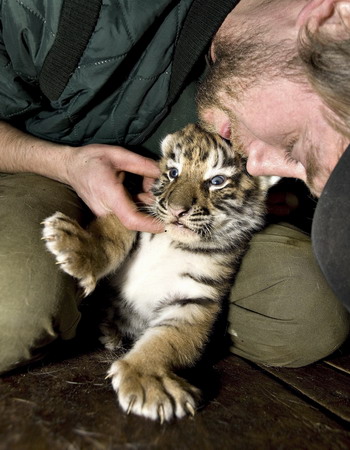
Quadruplet Siberian tigers meet the public (China Daily)

One of four newly born Siberian tiger cubs poses for the media at Aalborg Zoo, Denmark January 23, 2008. [Agencies]


Keeper Mikkel Kibsgaard displays one of four newly born Siberian tiger cubs at Aalborg Zoo, Denmark Janaury 23, 2008. [Agencies]


Keeper Mikkel Kibsgaard cuddles one of four newly born Siberian tiger cubs at Aalborg Zoo, Denmark January 23, 2008. [Agencies]


Keeper Mikkel Kibsgaard displays newly born quadruplet Siberian tiger cubs at Aalborg Zoo, Denmark January 23, 2008. [Agencies]


Wednesday, January 9, 2008

From June, shops can't give free plastic bags (China Daily)

A nationwide campaign against plastic bags has been launched, with the government banning production of ultra-thin bags and forbidding supermarkets and shops from handing out free carriers from June 1.

People use too many of the bags and fail to dispose of them properly, wasting valuable oil used in their production, and littering the country, the State Council said in a notice posted on the central government website (www.gov.cn).

Starting from June, shops, supermarkets and sales outlets will be forbidden from offering free plastic bags and all carriers must be clearly marked with prices. "We should encourage people to return to carrying cloth bags, using baskets for their vegetables," the notice said. In addition, the manufacture, sale and use of bags less than 0.025 mm thick are banned from the same date, with firms that flout the rules facing fines or confiscation of goods and profits.

The State Council also:
  • told finance authorities to consider tax measures to discourage the production and sale of plastic bags and encourage the recycling industry.
  • told quality inspection authorities to revise State standards for plastic bags and set up a monitoring mechanism
  • urged rubbish collectors to separate plastic for reprocessing and reduce the amount burnt or buried.
Residents in the country use up to 3 billion plastic bags a day and the country has to refine 5 million tons (37 million barrels) of crude oil every year to make plastics used for packaging, according to a report on the website of China Trade News (www.chinatradenews.com.cn) .

Link